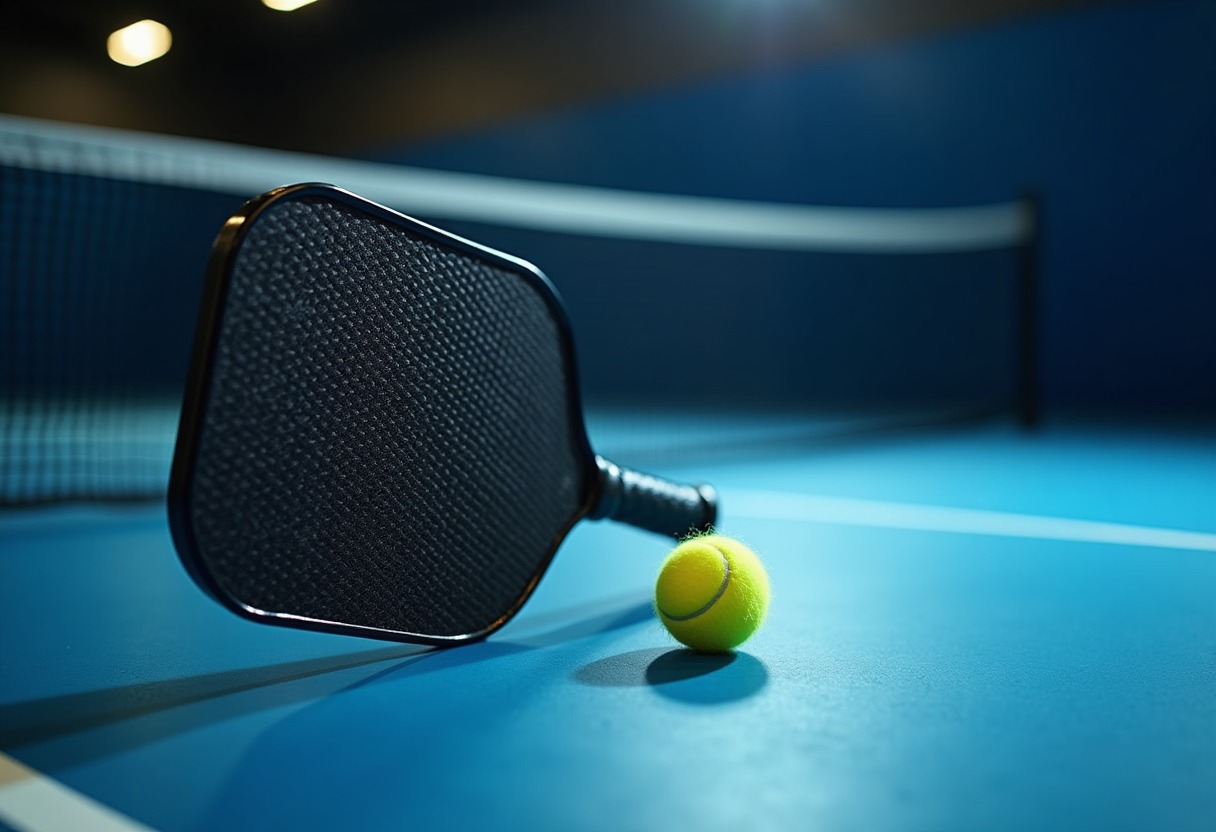
Advanced players need paddles that respond to micro-adjustments in swing path, generate measurable spin differences, and maintain consistency across 50+ rally exchanges. The difference between a 4.0 paddle and a tournament-ready model shows up in specific metrics: raw surface friction coefficients above 0.70, deflection rates under 3mm at impact, and swing weight distributions that favor maneuverability without sacrificing mass at contact.
What Makes an Advanced Pickleball Paddle Different
Tournament paddles separate themselves through manufacturing precision that recreational models can't match. Thermoformed unibody construction eliminates the edge guard entirely, creating a uniform hitting surface that extends to the paddle perimeter—this adds roughly 12% more usable face area compared to traditionally molded paddles. → Shop thermoformed pickleball paddles on Amazon
Carbon fiber face materials matter at advanced levels because they maintain texture longer. Raw carbon surfaces generate spin through mechanical friction rather than chemical grip, so they perform consistently even after 200+ hours of play. USA Pickleball regulations set surface roughness limits at 30 micrometers, and quality carbon maintains readings between 25-28 micrometers through extended use.
Core thickness affects more than just power output. The shift from 13mm to 16mm cores changes the paddle's moment of inertia—16mm cores typically measure 0.029-0.031 kg·m², providing 15-18% more stability on off-center hits compared to thinner options. Advanced players hitting consistent sweet spot contact can opt for 14mm cores to gain pop, but the forgiveness trade-off shows up immediately in tournament pressure situations.
Handle length directly impacts two-handed backhand effectiveness and reach on wide balls. Standard 5.25" handles work for most grips, but elongated paddles with 5.5-6" handles add 0.5-0.75 inches to total paddle length, measurably extending your court coverage. USA Pickleball caps combined length and width at 24 inches, so manufacturers balance these dimensions carefully.
Key Performance Categories for Advanced Play
Advanced paddles optimize for specific play styles that emerge at 4.5+ ratings. Control specialists need paddles with higher static weight (8.3-8.7 oz) positioned toward the handle, creating swing weights around 112-116. Power baseliners prefer head-heavy balance points 1-1.5 cm above center with swing weights reaching 120-124. All-court players split the difference with neutral balance and moderate swing weights of 116-119.
Surface roughness generates spin mechanically. Raw carbon fiber creates friction coefficients between 0.68-0.74 depending on weave pattern and resin treatment. Textured polymer surfaces measure slightly lower at 0.62-0.68 but wear more predictably. Top players generate 1800-2200 RPM on aggressive topspin drives—the paddle surface accounts for roughly 40% of that spin potential, with swing mechanics providing the rest.
Core materials determine feel more than marketing suggests. Polymer honeycomb cores offer the most consistent performance across temperature ranges, maintaining deflection characteristics from 40-95°F. Nomex cores provide a firmer, more responsive feel but amplify vibration—beneficial for precise touch players who want immediate feedback. Aluminum cores sit between these extremes but appear less frequently in modern advanced paddles.
Edge weighting through carbon fiber wrapping or foam inserts shifts the sweet spot and affects twist resistance. Paddles with reinforced edges show 20-25% less horizontal rotation on hits near the paddle's outer third. This stability matters when you're countering drives or blocking hard serves where contact happens away from center.
Advanced Paddle Comparison: Tournament-Tested Models
| Feature | Power-Focused | Control-Focused | All-Court | Spin-Specialized | |---------|---------------|-----------------|-----------|------------------| | Core Thickness | 13-14mm | 16mm | 14-16mm | 14mm | | Surface Material | T700 carbon fiber | Raw carbon/textured | Hybrid carbon | Gritty carbon weave | | Sweet Spot Size | Medium (22-24 sq in) | Large (26-28 sq in) | Medium-Large (24-26 sq in) | Medium (23-25 sq in) | | Balance Point | 1.2-1.5cm head-heavy | 0.5-0.8cm handle-heavy | 0.3-0.5cm neutral | 0.8-1.0cm head-heavy | | Optimal Player | Aggressive baseline | Soft game specialist | Versatile tournament | Drive/spin style | | Price Range | $180-$240 | $160-$220 | $170-$230 | $185-$245 |
Tournament-Ready Paddle Recommendations
Thermoformed Carbon Fiber Models: These represent current tournament standards. Carbon fiber construction with unibody molding creates paddles where the face, edge, and core form a single integrated structure. Expect static weights between 8.1-8.5 oz with handle weighting that keeps swing weight manageable despite the solid feel. The consistent response across the face makes them ideal for players who've refined their mechanics and want predictable ball response. Price range sits at $185-$235 for legitimate thermoformed models.
Elongated High-Performance Paddles: Elongated designs measuring 16.5-17 inches in length provide measurable advantages for players with solid court positioning. The extra reach helps on stretched volleys and defensive resets, while the longer handle accommodates two-handed backhands more comfortably. These typically pair elongated shape with 14-16mm cores for balanced performance. Best suited for players who've transitioned from tennis or those who play primarily doubles where reach at net matters. Look for models between $165-$215 that maintain total dimensions within USA Pickleball specs.
Raw Carbon Spin-Optimized Paddles: Raw carbon surfaces without polymer coating maximize spin generation through direct fiber-to-ball contact. These paddles require break-in periods of 5-10 hours before they reach peak texture performance, then maintain that friction coefficient for 150+ hours. The grittier feel provides exceptional feedback on ball contact, helping advanced players dial in precise spin rates. Pair these with your best pickleball balls for outdoor play to maximize the spin advantage. Tournament models run $190-$245.
Control-Optimized 16mm Core Models: Thicker cores favor touch players who control pace through placement rather than power. The extra 2-3mm of core material compared to standard paddles increases dwell time by 0.3-0.5 milliseconds—enough to improve directional control on soft hands exchanges. These paddles excel at kitchen line battles and require less swing effort for effective resets. Static weights typically range 8.4-8.8 oz with balance points favoring handle or neutral positioning. Quality options start at $155 and extend to $220 for premium materials.
Professional-Grade USAPA Approved Paddles: All serious tournament play requires USA Pickleball approval, but advanced models undergo additional testing for surface roughness limits and deflection characteristics. Look for paddles specifically marketed with current year USAPA approval stamps, as regulations update periodically. These models guarantee legal surface texture and appropriate power levels for sanctioned competition. Prices range widely from $145-$255 depending on construction methods and materials. → Shop USAPA approved tournament paddles on Amazon
What Tournament Players Actually Test For
Most paddle reviews miss the specific metrics that matter in competitive situations. Here's what to evaluate before committing to an advanced paddle:
Twist weight resistance: Hold the paddle loosely at the handle end and drop a ball onto the outer edge about 2 inches from the side. A quality advanced paddle will rotate less than 15 degrees. Poor twist resistance means off-center hits—common when opponents target your paddle edges—result in unpredictable ball direction.
Vibration dampening through the handle: Strike the paddle face with your knuckle at various points. Excessive vibration that resonates into your grip signals inadequate dampening that leads to pickleball elbow issues over time. Quality handles with foam or rubber dampening layers reduce transmitted shock by 35-40% compared to basic wrapped handles.
Temperature performance consistency: Advanced paddles should maintain pop and feel across temperature ranges you'll encounter. Polymer cores perform best here, showing minimal stiffness changes between 50-85°F. If you play in varying conditions, test paddles in both cool mornings and hot afternoons before deciding.
Edge guard integration quality: Even on thermoformed models without traditional edge guards, inspect how the paddle perimeter handles contact. Poorly finished edges chip and delaminate with court strikes or paddle clashes at the net. Run your finger along the entire perimeter—you shouldn't feel separation layers or rough transitions.
Grip size compatibility with replacement grips: Stock grips rarely match individual preferences. Verify that your paddle accepts standard replacement grips without excessive buildup. Most advanced players prefer 4.125-4.25" grip circumferences after adding their preferred overgrip or replacement grip. Test with your actual grip setup, not the factory handle.
Advanced Paddle Maintenance for Consistent Performance
Carbon fiber surfaces require minimal maintenance but benefit from specific care. Clean your paddle face after every session with a lightly dampened microfiber cloth—no chemicals needed. Built-up ball residue reduces surface friction by 8-12% after just three sessions, directly impacting spin generation.
Store paddles at room temperature away from direct sun. Carbon fiber itself handles temperature well, but adhesives bonding the face to core can degrade with repeated heat cycling above 120°F. Car trunks in summer commonly exceed this, potentially reducing paddle lifespan by 30-40%.
Inspect the paddle face weekly for delamination signs. Press firmly across the entire surface—any soft spots or unusual give indicates separation between face and core layers. Catching delamination early prevents complete failure during play. Most quality paddles include warranties covering manufacturing defects for 6-12 months.
Frequently Asked Questions
What weight paddle do professional pickleball players use? Most professional players use paddles between 8.0-8.5 oz static weight, with specific preferences varying by play style. Power players often go slightly heavier (8.3-8.5 oz) while control specialists sometimes prefer 7.9-8.2 oz. Swing weight matters more than static weight—professionals typically use paddles with swing weights between 115-122 depending on their strength and swing mechanics.
How long do high-end carbon fiber paddles last? Quality carbon fiber paddles maintain peak performance for 200-300 hours of play, equivalent to 12-18 months for players logging 3-4 sessions weekly. The surface texture degrades gradually rather than suddenly, losing 10-15% of initial friction coefficient by 200 hours. Core integrity usually outlasts surface performance—many players replace paddles due to reduced spin capability rather than structural failure.
Should advanced players use 14mm or 16mm cores? The choice depends on your specific play style and physical game. Players with consistent mechanics who generate pace through swing speed benefit from 14mm cores that provide more pop and faster ball response. Players who rely on touch, resets, and controlled pace prefer 16mm cores that increase dwell time and forgiveness. If you're transitioning up from intermediate paddles, try both thicknesses in similar models to feel the difference.
Do elongated paddles really improve reach at the net? Yes, measurably. Elongated paddles add 0.5-1 inch of effective reach compared to standard shapes, which translates to covering an additional 3-4 inches of court when stretched. This advantage shows up most in doubles play during volleys and defensive situations. The trade-off comes in slightly reduced maneuverability and a smaller optimal hitting zone, so players need solid mechanics to benefit from elongated designs.
How much should I spend on an advanced tournament paddle? Budget $165-$245 for legitimate advanced paddles with current technology and materials. Below $150, you're typically getting previous-generation designs or recreational builds that won't hold up to tournament intensity. Above $250, you're often paying for pro player endorsements rather than meaningful performance improvements. The sweet spot for value sits at $180-$220 where you get thermoformed or premium carbon construction without excessive markup.
Tournament Performance Starts With the Right Tool
Advanced paddles earn their cost through measurable performance advantages that show up most when the score matters—consistent spin generation, predictable power output, and forgiveness on the off-center hits that happen under pressure.
Some links on this page are affiliate links. We may earn a small commission if you purchase through them, at no extra cost to you.
As an Amazon Associate we earn from qualifying purchases. This article contains affiliate links; if you buy through them we may earn a small commission at no additional cost to you.