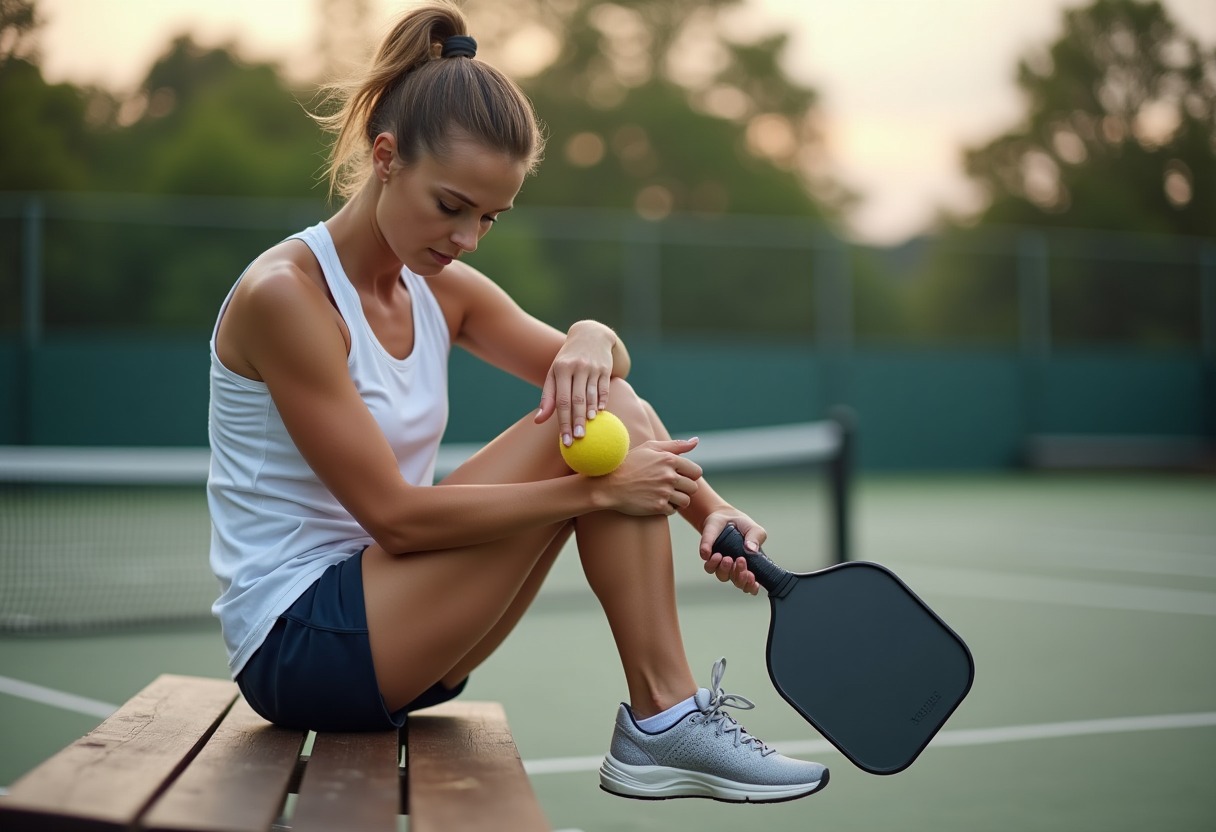
The fastest-growing sport-related injury in adults over 50 isn't a knee tear or a back strain — it's lateral epicondylitis from pickleball, commonly called pickleball elbow. The mechanism is identical to classic tennis elbow, but pickleball's accessibility means millions of people who never picked up a racquet before are now hitting 80 dinks per game three times a week with poor mechanics. The injury follows.
The good news: pickleball elbow is almost entirely preventable, and when it does develop, it's recoverable within 6–12 weeks with the right protocol. Here's the playbook.
What Pickleball Elbow Actually Is
Lateral epicondylitis is a degenerative condition (not really an inflammation, despite the "-itis" suffix) of the tendons that attach the forearm extensor muscles to the bony bump on the outside of your elbow. Repeated wrist and forearm extension under load — like absorbing a hard incoming dink — creates microscopic tears in the tendon. With adequate rest, they heal. Without it, they accumulate, and the tendon develops scar tissue that doesn't function the way the original tissue did.
The pain almost always presents on the outer (lateral) side of the elbow, often radiating down the back of the forearm toward the wrist. Classic tells:
- Pain on extension. Picking up a coffee mug. Twisting a doorknob. Shaking hands.
- Morning stiffness that loosens after 10–15 minutes of movement, then returns later in the day.
- Pain during dinks more than drives. Because dinks require fine extensor control with the elbow slightly extended, they irritate the tendon more than full power swings do.
- Weakness in grip strength that surprises you when opening a jar.
If you have point tenderness on the outer elbow bone itself, plus any of the above, you almost certainly have pickleball elbow.
The Five Equipment and Technique Causes
Most pickleball elbow cases trace back to one or more of these five root causes. Fix them and the injury rarely returns; ignore them and you'll be in a brace for the rest of your playing career.
1. Paddle Too Heavy
The default pickleball paddle weight has crept up over the past few years as players chase more power. Anything over 8.2 oz puts repeated load on the forearm tendons every swing. If you've recently switched to a heavier paddle and the elbow pain started 4–8 weeks later, that's almost certainly the cause.
Fix: Drop to a 7.6–7.9 oz paddle. Yes, you'll lose a small amount of power. You'll gain back far more by being healthy enough to play.
2. Grip Too Small
A grip that's too small for your hand forces you to over-clench to keep the paddle from twisting on contact. That sustained over-clenching is one of the most efficient ways to develop lateral epicondylitis. Our grip tape and wrapping guide covers how to add overgrip layers to bulk up an undersized handle without buying a new paddle.
Fix: Use the finger test (fits one finger of your other hand between your fingertips and palm when gripping the paddle). If too small, stack a second overgrip or buy a thicker replacement grip.
3. Worn-Out Grip
A slippery grip causes the same over-clenching as a too-small grip — your forearm muscles work double to keep the paddle from rotating. Replace overgrips every 4–6 weeks of regular play.
4. Hard Balls and Stiff Paddles
A composite paddle with a 13mm core absorbs more shock than a carbon-fiber 16mm paddle. Hard outdoor balls (Dura Fast 40, Franklin X-40) transmit more shock to the arm than softer indoor balls. If you've recently switched from indoor to outdoor or moved to a stiffer paddle, the cumulative load increased.
Fix: If you're newly experiencing elbow pain, switch to a 14mm or thicker softer-core paddle for a few weeks while you recover. Some players permanently switch to softer paddles after a flare-up.
5. Hitting From the Wrist Instead of the Shoulder
This is the technique cause and the hardest to fix. Players who try to generate paddle speed primarily by snapping the wrist (instead of rotating the shoulder and core) hammer the extensor tendons. Watch a pro on YouTube — their paddle face is quiet at contact, the power comes from body rotation. If your dinks and drives look like a series of small wrist flicks, your technique is loading the elbow.
Fix: Take a lesson, even a single one. A coach can identify wrist-driven swings in 10 minutes and give you a corrected motion. This is the cheapest, highest-leverage fix.
The Recovery Protocol
Once pickleball elbow develops, you have three options, in order of preference:
Phase 1: Reduce Load (Weeks 1–3)
Stop playing pickleball. Yes, completely. "Just playing easy dinks for 30 minutes" is exactly the load that caused this, and you cannot heal a tendon you're continuing to micro-tear.
During this phase:
- Ice the elbow for 15 minutes after any activity that aggravates it.
- NSAIDs (ibuprofen, naproxen) for 5–7 days max if cleared by your doctor — they reduce pain but don't speed tendon healing.
- Counter-force brace (a strap that sits about 2 inches below the elbow bump) during daily activities. This redirects the load away from the inflamed insertion point. The Mueller Hg80 and Bauerfeind EpiTrain are well-reviewed.
→ Shop tennis/pickleball elbow braces on Amazon
Phase 2: Eccentric Loading (Weeks 3–8)
This is where most amateur recovery protocols fail — they go straight from "rest" back to "play." The missing piece is eccentric loading: slowly lowering a weight to strengthen the tendon in the lengthening phase. The research on this is overwhelming; it's the single most effective intervention for chronic tendon issues.
The drill: eccentric wrist extension with a 2–5 lb weight.
- Sit with your forearm resting on your thigh, palm down, holding a light dumbbell or soup can.
- Use your other hand to lift the weight up (concentric phase — not the part that heals you).
- Release your support hand and lower the weight slowly over 4–5 seconds (eccentric phase — this is the part that heals you).
- 3 sets of 15 reps, every other day.
Start with 2 lb. Add weight only when 15 reps no longer creates any fatigue. Mild discomfort during the exercise is OK and expected; sharp pain is not — back off the weight.
A physical therapist visit at this phase is worth the money even if you've Googled enough to know the protocol. They'll catch compensation patterns and add complementary work for the shoulder and grip.
Phase 3: Return to Play (Weeks 8–12)
When the eccentric drill is painless at 5 lb and you can grip a tennis ball without pain, you're ready to test play.
- Week 1 of return: 20 minutes of warm-up dinks only. No drives, no overheads, no third shot drops with intent.
- Week 2: 30 minutes including some drives at 50% power.
- Week 3: Full play at 75% intensity.
- Week 4+: Normal play, but continue the eccentric drill 1–2× per week indefinitely as maintenance.
If pain returns at any point, drop back two weeks and rebuild from there. This isn't a setback — it's the normal rhythm of tendon adaptation.
When to See a Doctor
Most pickleball elbow resolves with the protocol above. See a sports medicine doctor if:
- Pain doesn't improve at all after 4 weeks of full rest
- You have any locking, catching, or numbness in the hand or fingers
- The elbow is visibly swollen or warm to the touch
- Symptoms started after a specific traumatic event (rather than gradual onset)
Advanced cases sometimes benefit from PRP (platelet-rich plasma) injections or, in stubborn cases, percutaneous tenotomy. Surgery is rare and typically a last resort after 12+ months of failed conservative treatment.
Bottom Line
Pickleball elbow is a forearm and grip problem masquerading as a paddle problem. Fix your paddle weight, grip size, and grip wear first. Add a short daily warm-up that includes wrist circles and grip squeezes. Replace worn overgrips on the regular cadence covered in our grip tape guide. When pain shows up, stop playing immediately and start eccentric loading — the longer you wait, the longer the recovery. Done right, you'll be back on the court in 8–12 weeks and unlikely to deal with it again.
As an Amazon Associate we earn from qualifying purchases. This article contains affiliate links; if you buy through them we may earn a small commission at no additional cost to you.